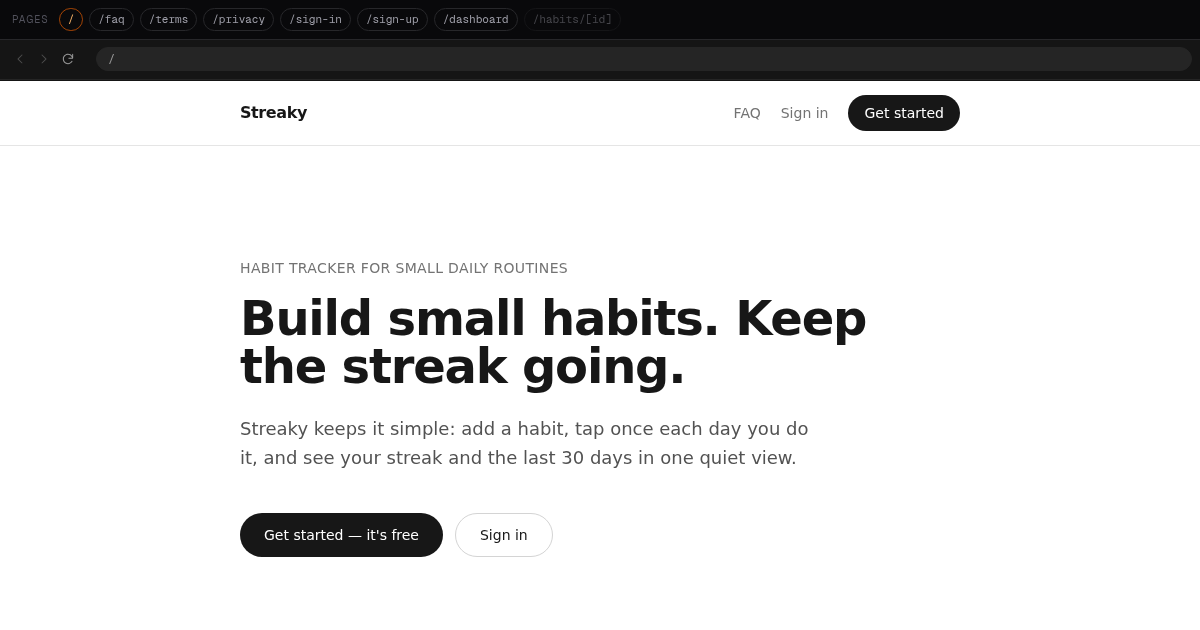
Most AI code generators output Next.js. This is not coincidence or fashion. It is the pragmatic choice for this particular use case.
Here is why, without the hype.
Everything in one place
Next.js app router puts pages, API routes, data fetching, and middleware in one file tree. For an AI generator, this matters enormously. The model can produce a complete application with consistent conventions and the output is immediately runnable.
Compare this to a stack of separate backend and frontend repos. Twice the coordination, twice the chance for the AI to produce mismatched pieces.
Hosting is flexible
Next.js runs on Cloudflare Pages via the adapter, on Netlify, on AWS, or a VPS. An app generated once can deploy anywhere.
This is why ContentForger output includes deploy instructions for multiple hosts. The framework does not lock you in. Your hosting decision can change when pricing changes.
TypeScript support is first class
AI-generated code has a specific failure mode: subtly wrong types that compile but break at runtime. TypeScript strict mode catches most of these at generation time, which means the output that reaches you has already passed a layer of validation.
Next.js ships with TypeScript ready. No configuration overhead.
The ecosystem fits
Supabase for auth and database, Stripe for payments, Resend for email, Sentry for monitoring. Every one of these has mature Next.js integration with documented patterns.
An AI generator can produce working auth flows, billing flows, and email flows because the patterns are well-documented and consistent. The model has training data on all of them.
Server components reduce client complexity
Server components mean the AI can generate data-fetching logic that runs on the server without writing useEffect dances. Less client-side state management, fewer bugs, simpler output.
This is a real quality improvement. Compare AI-generated React from two years ago, stuffed with useEffect and useState, to AI-generated Next.js 16 server components now. Night and day.
Deployment story is short
ContentForger can include three-sentence deploy instructions for Cloudflare Pages in a README and the user is done. Push to GitHub, connect to Cloudflare Pages, add env vars, deploy.
Frameworks with more complex deployment stories force the generator to produce more documentation to be useful. Next.js lets the generator produce less and have it still work.
The counterargument
Next.js is not the right choice for every project. If you need realtime-first architecture, a framework like SvelteKit or a more dedicated realtime stack may fit better. If you need static site generation for a blog, Astro is often more appropriate.
But for the kind of app an AI generator typically produces — a CRUD app with auth, billing, and a database — Next.js is the shortest path from prompt to working deployed application.
Why ContentForger chose Next.js 16 specifically
Three reasons.
App router conventions are stable now. The early wrinkles are ironed out. Generated output is less likely to hit an awkward edge case.
Server actions reduce the amount of API route boilerplate needed. The generator produces less code. Less code has fewer bugs.
The breaking changes in the Next.js 16 series are known and documentable. Await params in dynamic routes, for instance. A generator can enforce this pattern.
What this means for you
If you are using an AI generator in 2026, you are probably getting Next.js output whether you asked for it or not. This is usually the right answer. Lean into it. Learn the framework conventions. The skills transfer directly to any hand-written Next.js work.
The Next.js you get from ContentForger is the same Next.js a developer would write. Not a weird dialect, not a stripped-down subset. Real Next.js that runs wherever Next.js runs.